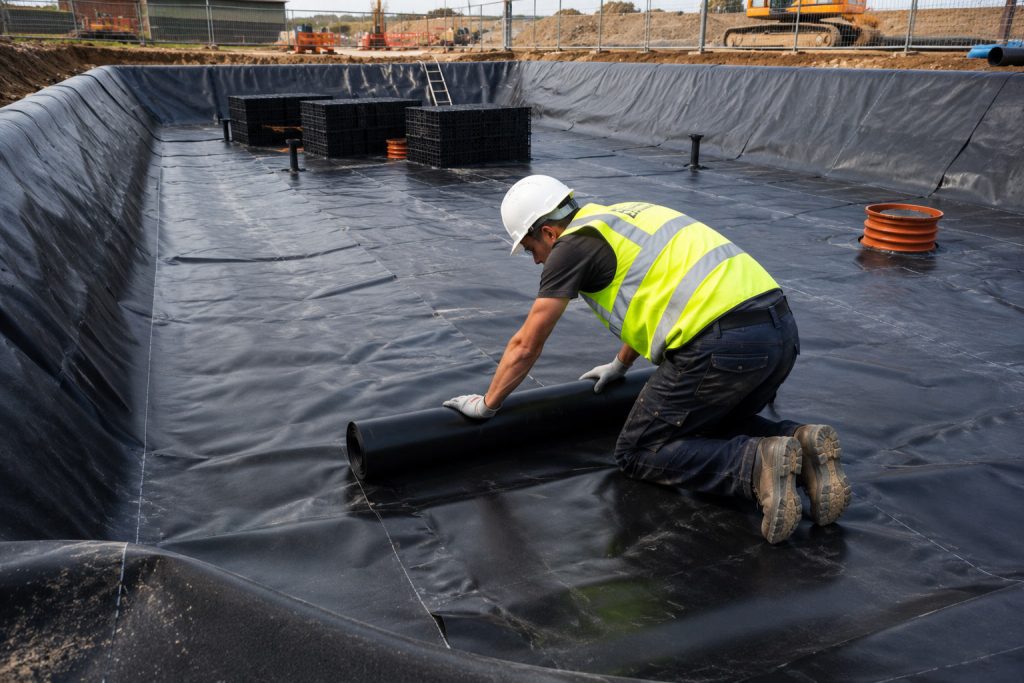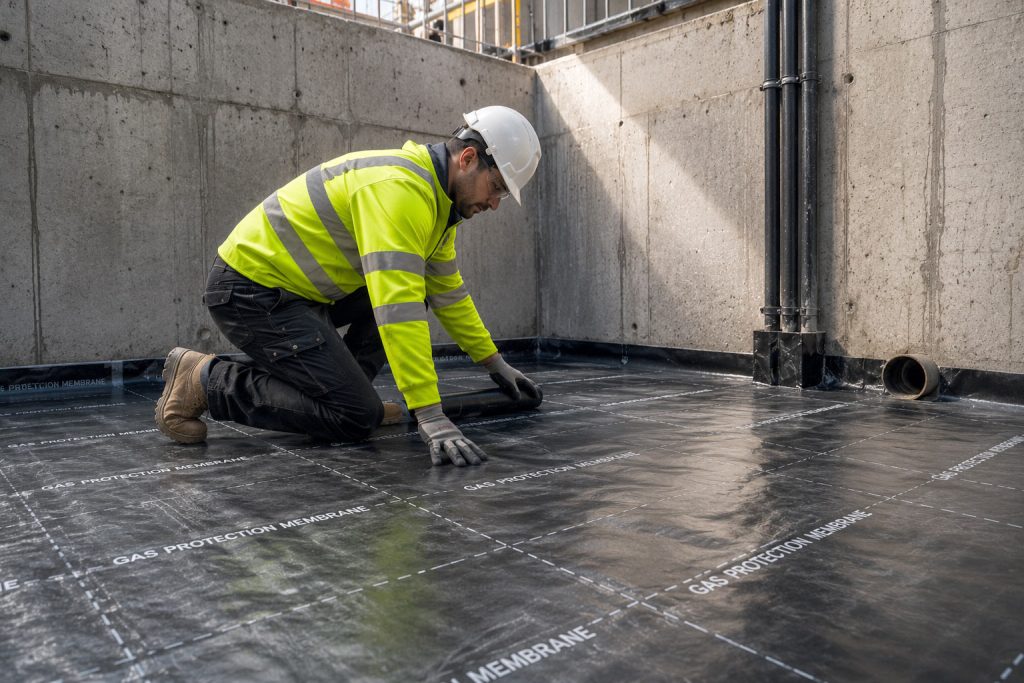
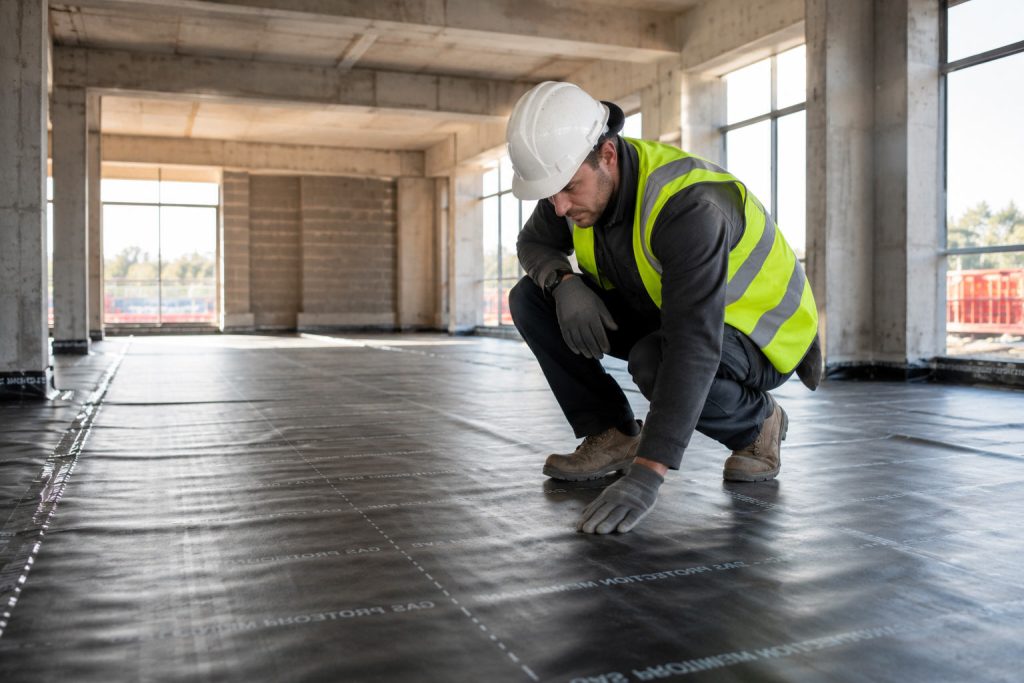
Ground gas membranes form an important part of the protection measures used on developments where gases such as methane, carbon dioxide or radon may present a risk. When correctly designed and installed, the membrane creates a continuous barrier between the ground and the occupied building above.
The difficulty is that even a good membrane system can be compromised by relatively small installation defects.
A poorly sealed joint, an unsealed service penetration or damage caused by another trade may create a pathway through what should otherwise be a continuous barrier. Many of these problems are not unusual or particularly complicated. In fact, the same types of defects tend to appear repeatedly during site inspections.
Understanding where things commonly go wrong can help contractors and installers prevent defects before they occur.
Here are ten of the most frequently encountered ground gas membrane installation defects and, importantly, how they can be avoided.
1. Poorly Sealed Membrane Joints
Membrane joints are one of the first areas to examine during an inspection.
Individual sheets of membrane must be joined to create a continuous gas-resistant barrier. If the joint is inadequately sealed, contaminated ground gas may potentially pass between the sheets.
Problems can include insufficient overlap, incorrectly positioned tapes, wrinkles within the joint or areas where surfaces have not bonded properly.
The manufacturer’s specified jointing method should always be followed. Membrane surfaces should also be clean and dry enough to achieve an effective seal.
Taking a little more time preparing each joint is considerably easier than repairing numerous defective joints later.
2. Damage Caused During Installation
Ground gas membranes are designed to be durable, but they are certainly not indestructible.
Punctures and tears can occur as the membrane is moved across rough surfaces or installed around reinforcement, foundations and other construction elements.
Even relatively small punctures matter because the purpose of the system is to create a continuous barrier.
The substrate should therefore be properly prepared before installation begins. Sharp projections, debris and other objects capable of damaging the membrane should be removed.
Any damage identified during installation should be repaired using an approved method before the area is covered.
3. Poorly Sealed Service Penetrations
Service penetrations are among the most challenging parts of many membrane installations.
Pipes, ducts, cables and drainage systems inevitably need to pass through the gas protection layer. Each penetration interrupts the membrane and must therefore be carefully detailed and sealed.
Simply cutting a hole in the membrane and attempting to tape around a pipe is unlikely to provide a satisfactory long-term detail.
Where appropriate, proprietary collars, top hats or other compatible components should be used. The detail should provide a secure connection between the membrane and the penetrating service without excessive tension or unsupported gaps.
Careful planning of service locations before membrane installation can prevent many of these problems.
4. Excessive Wrinkling and Creasing
Some movement and folding of flexible membranes is unavoidable, particularly around corners and complex details.
Excessive wrinkling, however, can cause problems.
Large creases may prevent tapes and sealing products from making continuous contact with the membrane. They can also make subsequent construction more difficult and create vulnerable points where the membrane may be damaged.
Membrane sheets should be positioned carefully rather than stretched or forced into place.
Where complex geometry is involved, properly formed details are generally preferable to attempting to fold a large sheet into several different planes.
5. Incorrect Detailing at Corners
Corners can look deceptively simple on a drawing.
On site, they often involve several pieces of membrane meeting within a relatively small area. Poor folding or cutting can leave gaps, excessive material or difficult-to-seal junctions.
Internal and external corners require particular attention.
Where proprietary corner units are available, these may help provide a more consistent detail. Alternatively, site-formed corners should follow the approved installation method and be fully sealed.
The completed detail should be inspected carefully before other materials restrict access.
6. Poor Connections to the Damp-Proof Course
A gas membrane should not be viewed as an isolated sheet beneath the floor. It forms part of a wider protection system that needs to maintain continuity across the building envelope.
Connections between the gas membrane and damp-proof course can therefore become critical points.
Misalignment, insufficient overlap or incomplete sealing can interrupt the intended barrier.
These interfaces should be considered during the design and planning stage rather than improvised during installation.
Installers also need sufficient access to form the connection correctly. Trying to complete a complicated perimeter seal after walls or other construction elements have restricted access can make an otherwise straightforward detail unnecessarily difficult.
7. Membrane Bridging Voids or Changes in Level
A membrane should generally be adequately supported.
Problems can occur where it bridges gaps, voids or abrupt changes in the substrate. Once subsequent construction loads are applied, unsupported membrane may stretch, tear or puncture.
Changes in level require particular attention.
Rather than pulling the membrane tightly across a step or corner, enough material should be provided to accommodate the geometry without placing the membrane under excessive tension.
Where necessary, additional protection or specifically designed details should be used.
8. Contaminated Surfaces Preventing Adhesion
Construction sites are rarely clean environments.
Dust, mud, standing water and general construction debris can all affect membrane jointing and sealing. This is particularly important where adhesive tapes or other bonded products are being used.
A tape applied over a dusty or wet membrane may initially appear attached but fail to achieve the intended bond.
Surfaces should be prepared in accordance with the membrane manufacturer’s instructions before jointing begins.
Good housekeeping around the installation area can make a surprisingly large difference to the quality of the completed work.
9. Damage Caused by Following Trades
A membrane can be installed perfectly and still be damaged afterwards.
This is one of the most common practical challenges associated with ground gas protection.
Once the membrane has been installed, other trades may need to work above or around it. Reinforcement, insulation, temporary supports, tools, materials and even routine foot traffic can introduce punctures or tears.
The membrane should therefore be protected as far as reasonably practical once installation is complete.
Site teams should also understand that it is a functional part of the building rather than simply another sheet of material on the floor.
Ideally, final inspection should take place as close as practical to the point at which the membrane will be permanently protected or covered.
10. Covering the Membrane Before Inspection
Perhaps the most avoidable problem is allowing the membrane to be covered before the required inspection or testing has taken place.
Once insulation, reinforcement, screed or concrete has been installed above the membrane, access may be severely restricted or lost completely.
At that point, defects cannot easily be identified and evidence of the installation may be limited.
If adequate verification cannot be achieved, opening-up works could be required. This adds cost, causes delays and may itself risk further damage.
The solution is straightforward: verification should be planned before membrane installation begins.
Inspection stages and hold points can then be incorporated into the construction programme so that critical areas are checked while they remain accessible.
Why Early Inspection Matters
Most membrane defects are easier to correct when identified early.
A defective joint discovered while the membrane is exposed may require only a relatively simple repair. Discovering the same problem after reinforcement, insulation or concrete has been installed above it is a very different situation.
Early inspection can also reveal recurring workmanship issues.
If the first few service penetrations have been incorrectly detailed, for example, identifying the problem immediately allows the installation method to be corrected before dozens more penetrations are completed in the same way.
Verification should therefore be viewed as an ongoing part of the installation process rather than simply a final visit.
Preventing Ground Gas Membrane Defects
Good workmanship is essential, but preventing defects starts before the first membrane sheet is unrolled.
The installation team needs appropriate drawings, specifications and installation details. The substrate needs to be suitable, interfaces must be understood and penetrations should be planned wherever possible.
There also needs to be coordination between the installer, main contractor, verifier and following trades.
A clear verification plan can establish when inspections are required and identify hold points beyond which work should not proceed until the relevant checks have been completed.
Perhaps most importantly, everyone working around the membrane needs to recognise its purpose.
A small puncture may appear insignificant on a busy construction site, but when the membrane is intended to provide a continuous barrier against ground gas, small defects can matter.
Getting the Installation Right First Time
Ground gas membrane defects are not always the result of major installation failures. More often, they involve relatively small details: a poorly prepared joint, an awkward corner, a pipe penetration that has not been properly sealed or damage caused after installation.
These are also precisely the types of problems that careful planning, good workmanship and staged inspection can help prevent.
By considering difficult details before installation begins, protecting completed areas and arranging verification before the membrane is covered, contractors can substantially reduce the likelihood of defects being carried forward into the completed building.
Ultimately, successful ground gas protection depends on continuity. Every joint, penetration, corner and interface forms part of the same barrier.
Getting those details right — and checking them while they are still visible — is what turns a sheet of membrane into an effective ground gas protection system.