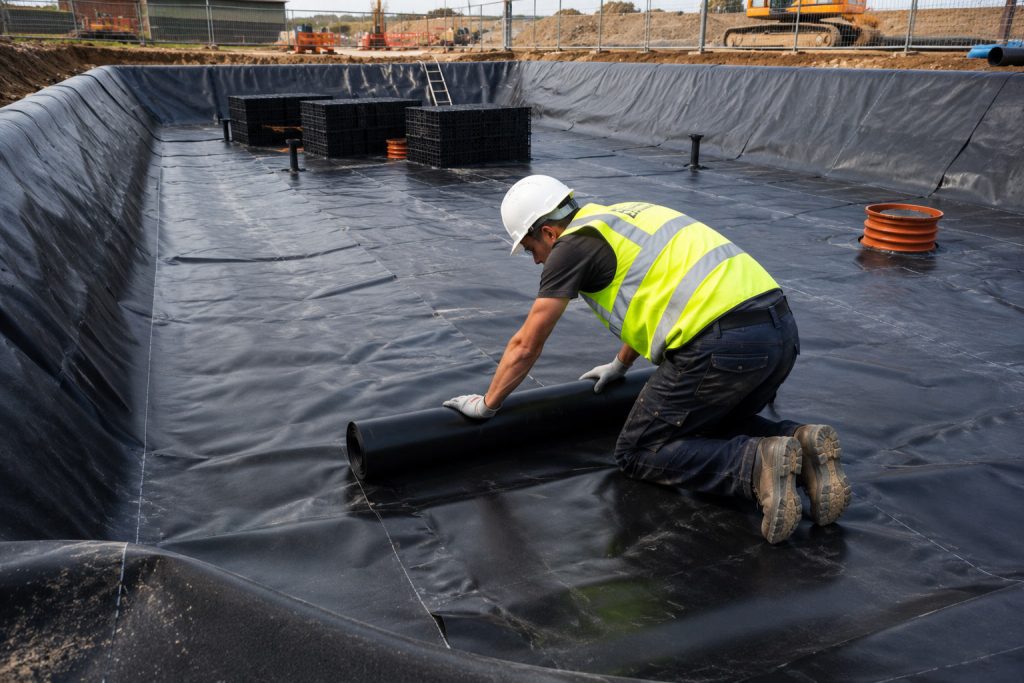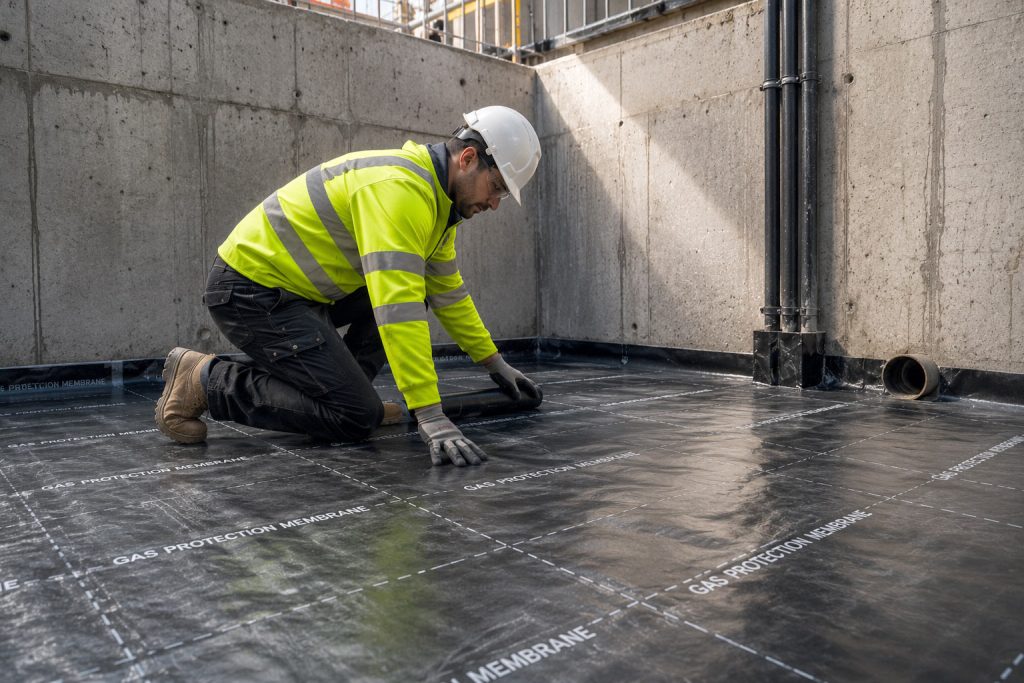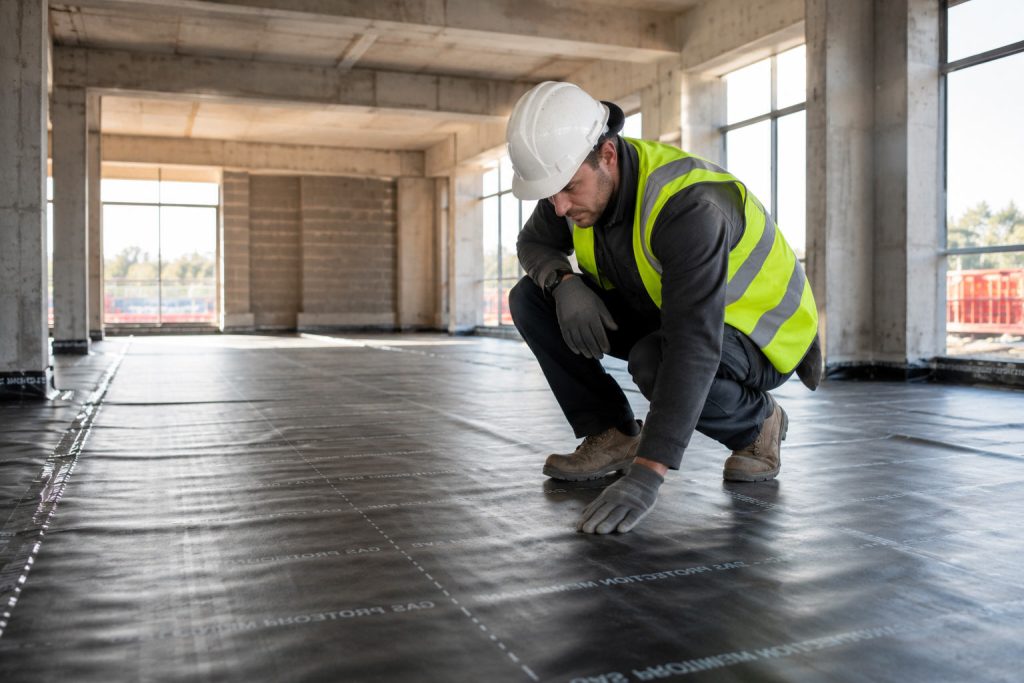
Ground gas protection is one of those elements of construction that can become almost invisible once a project moves forward. A membrane may be carefully installed across a floor slab, sealed around service penetrations and connected to the damp-proof course, but within a relatively short period it can disappear beneath insulation, screed or other finishes.
That creates an obvious problem: once the gas protection system has been covered, how can anyone reliably verify that it was installed correctly?
For this reason, ground gas verification should not be treated as an inspection arranged towards the end of the installation. It needs to be planned before installation begins, with clear inspection stages, responsibilities and hold points agreed in advance.
Good planning allows verification to take place while the critical parts of the system remain accessible. It can also reduce delays, prevent unnecessary opening-up works and provide a much clearer record of how the completed gas protection system was installed.
What Is Ground Gas Verification?
Ground gas verification is the process of providing evidence that an installed gas protection system meets the requirements of the project design and specification.
Depending on the site, the system may be intended to protect a building from gases such as methane, carbon dioxide or radon, as well as ground conditions associated with contaminated land.
Verification is not simply a final visual check.
It may involve reviewing materials, inspecting membrane installation, checking joints and seals, examining penetrations and interfaces, carrying out integrity testing where appropriate, recording defects and confirming that remedial work has been completed.
The resulting records provide evidence of the condition of the system at important stages of construction.
The Importance of a Ground Gas Verification Plan
A verification plan sets out how the installation will be inspected, tested and documented before work begins.
Rather than deciding what needs checking once the membrane is already being installed, the plan establishes the verification process in advance.
A typical plan may identify:
- the gas protection system being installed;
- relevant drawings, specifications and performance requirements;
- areas requiring inspection;
- critical construction details and interfaces;
- proposed inspection stages;
- testing requirements;
- photographic and documentary evidence required;
- responsibilities for notifying the verifier;
- procedures for recording and rectifying defects; and
- the information required for the final verification report.
The level of verification should be appropriate to the complexity of the project and the risks associated with the site.
A relatively straightforward installation may require fewer inspection stages than a large development containing numerous service penetrations, changes in level and complex structural interfaces.
The important point is that the required level of verification is considered before the membrane begins to disappear beneath the building.
Establishing Inspection Stages
Attempting to verify an entire gas membrane installation during a single site visit is rarely the best approach.
Installation normally progresses in stages, and different parts of the membrane become inaccessible at different times. Verification should follow that construction sequence.
An initial inspection might take place once a representative section has been installed. This can provide an early opportunity to identify problems with workmanship or interpretation of the design before the same detail is repeated throughout the building.
Further inspections can then be arranged around significant stages of installation.
These may include checking membrane joints, corners, changes in level, pile penetrations, service entries, drainage penetrations and interfaces with walls or damp-proof courses.
Where integrity testing forms part of the verification strategy, it also needs to be scheduled while the relevant membrane remains accessible.
This staged approach has another practical advantage. If a recurring installation problem is identified early, it can usually be corrected before hundreds of square metres of membrane have been installed using the same method.
What Are Hold Points?
A hold point is a defined stage of construction beyond which work should not proceed until a specified inspection or verification activity has taken place.
In ground gas protection, the most important hold point is often immediately before the membrane is covered.
For example, the construction programme may require the membrane to be inspected before insulation, reinforcement, screed or a concrete slab is installed above it.
Other hold points may be established around particularly important details, such as complex penetrations or connections between different elements of the gas protection system.
The principle is simple:
the verifier needs access to the work while there is still an opportunity to inspect it and, if necessary, correct it.
Hold points should therefore be incorporated into the construction programme rather than treated as unexpected interruptions.
When everyone understands the inspection requirements in advance, site teams can notify the verifier at the appropriate stage and subsequent trades can be scheduled accordingly.
What Happens When a Membrane Is Covered Too Early?
One of the most difficult situations arises when the verifier arrives on site to discover that a significant area of membrane has already been covered.
At that point, visual access to the installation may be limited or completely lost.
Photographs taken during installation can certainly be useful, but photographs do not necessarily provide the same level of evidence as a planned inspection. They may not show every joint, penetration or interface, and the condition of the membrane immediately before covering may not have been recorded.
There is also a practical issue.
If adequate evidence cannot be obtained, sections of the construction may need to be opened up to allow inspection. That can mean removing insulation, screed, reinforcement or other materials that have already been installed.
Opening-up works can add cost, disrupt the programme and potentially introduce further risk of damage to the membrane.
In some circumstances, it may simply be impossible to provide the same level of verification retrospectively.
Verification Is More Than Finding Defects
It is easy to think of verification primarily as a way of finding holes or poorly sealed joints. In practice, it serves a broader purpose.
Verification provides an independent record of the installation process.
That record may include photographs, inspection notes, test results, details of defects and evidence of remedial works. Together, these documents help demonstrate how the installed system relates to the specified design.
This distinction matters because a gas protection membrane is a concealed construction element.
Once the building is complete, the finished floor gives very little indication of what lies beneath it. A structured verification process creates evidence while the work can still be seen.
Coordination Between Installer, Contractor and Verifier
Successful verification depends heavily on communication.
The verifier needs to understand the construction programme, while the installer and principal contractor need to know when inspections are required.
Problems often occur when verification is treated as something that can simply be arranged at short notice.
For example, an installer may finish a large section of membrane on Tuesday afternoon with insulation scheduled for Wednesday morning. If the verifier is only contacted on Tuesday evening, attending before the membrane is covered may not be practical.
A verification plan helps remove this uncertainty.
It can define notification periods, inspection stages and hold points before work starts. The contractor can then incorporate those requirements into the programme and coordinate subsequent trades around them.
Planning Verification Can Save Time
It may appear that adding inspection stages and hold points will slow construction down. In reality, proper planning is likely to have the opposite effect.
A short, scheduled inspection is usually far less disruptive than discovering later that sufficient evidence is unavailable.
Similarly, correcting a membrane detail while it remains exposed is considerably easier than removing completed construction to reach it.
Early verification can also identify repeated workmanship issues before they spread across the project.
The objective is not to create unnecessary barriers to progress. It is to make verification part of the normal construction sequence.
Creating a Defensible Verification Record
The final verification report should not be the first time verification is considered.
It is the end result of a process that begins before installation and continues through the relevant stages of construction.
A well-planned verification process creates a logical chain of evidence: what was specified, what was inspected, what was tested, what defects were identified, how those defects were corrected and what was ultimately accepted.
That provides developers, contractors, designers and other stakeholders with a much clearer record of the installed gas protection system.
Plan Verification Before the Membrane Goes Down
Ground gas membranes perform an important protective function, yet much of the system becomes inaccessible remarkably quickly.
Waiting until installation is substantially complete before arranging verification can leave critical areas hidden, limit the evidence available and, in some cases, lead to costly opening-up works.
A verification plan established before installation provides a much better approach.
By agreeing inspection stages, testing requirements, responsibilities and hold points in advance, verification becomes part of the construction programme rather than an obstacle to it.
Most importantly, it allows the installation to be inspected while there is still something to inspect.
For ground gas protection systems, that timing can make the difference between a clear, well-documented verification record and trying to establish what happened after the evidence has already been covered.