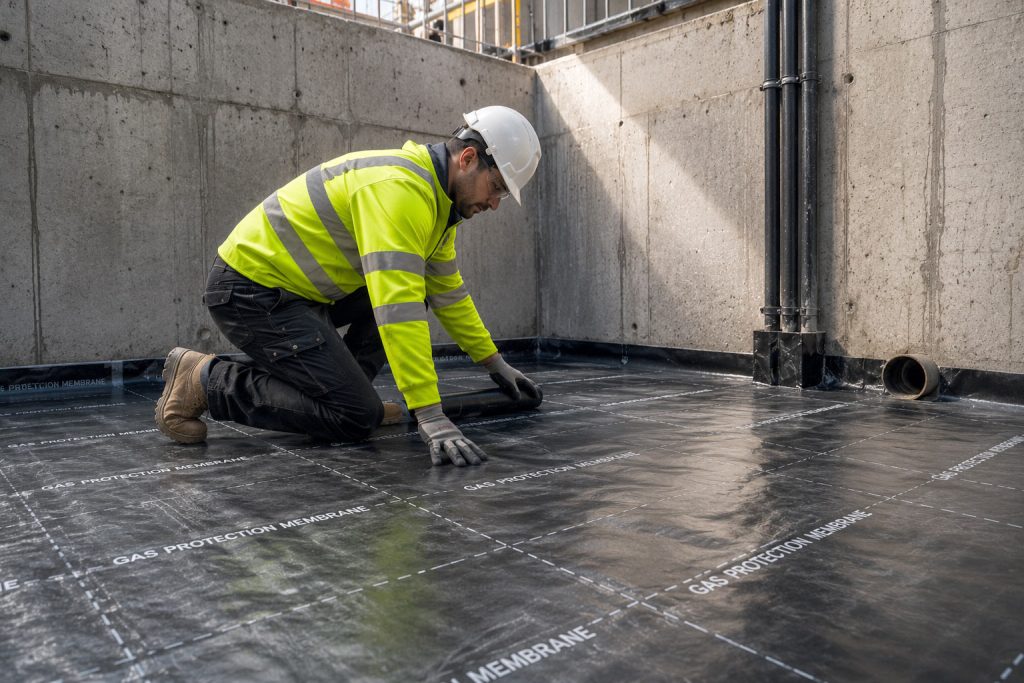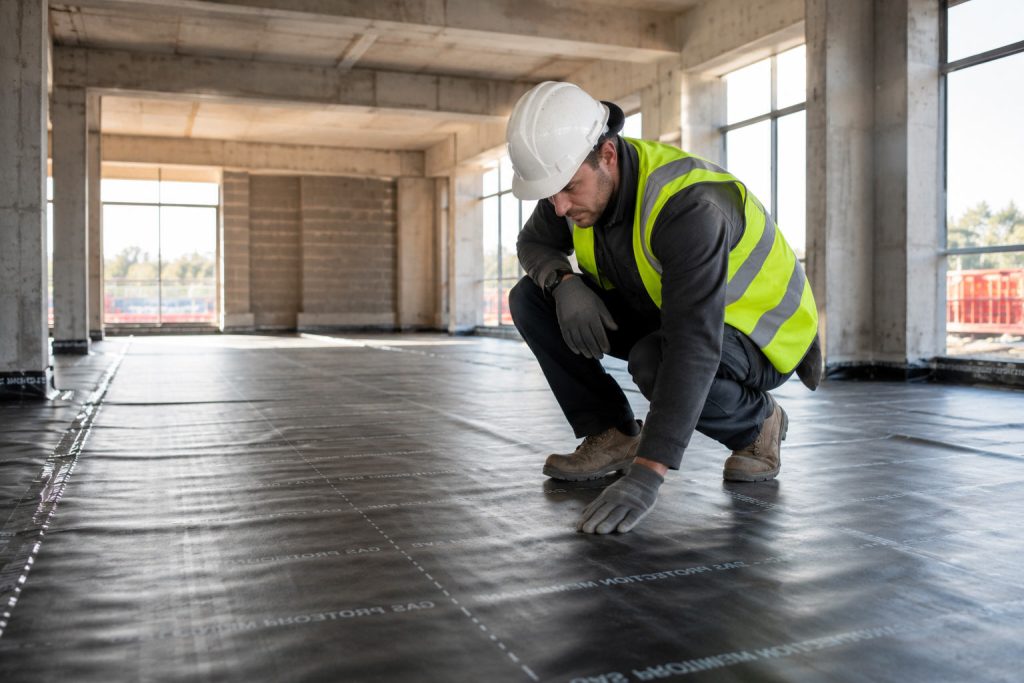
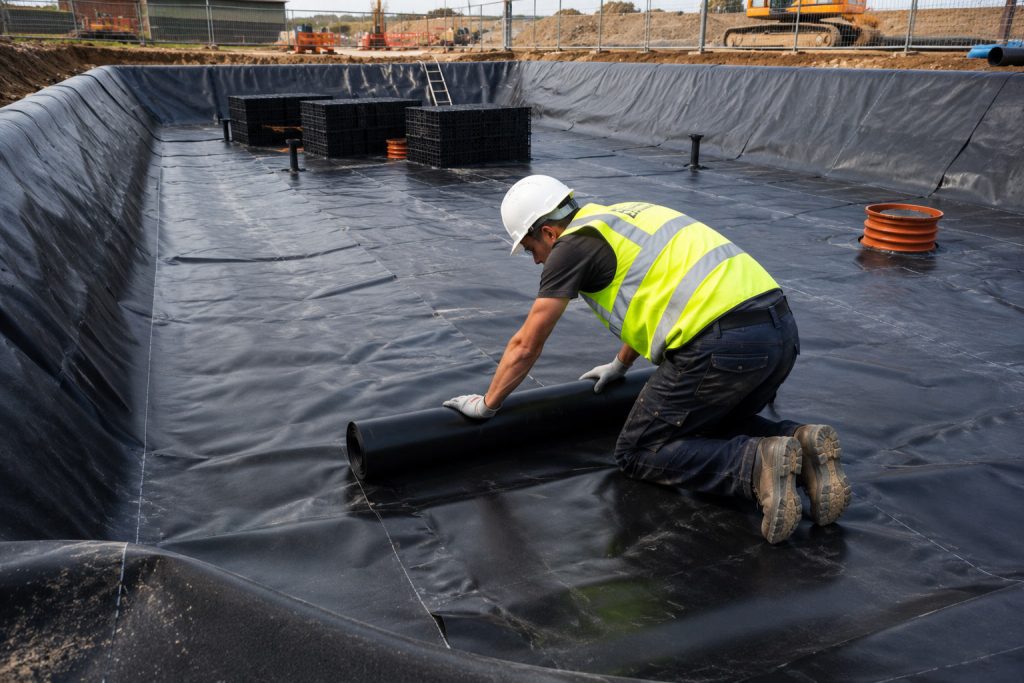
Attenuation tanks are now a familiar feature of drainage and sustainable drainage systems on developments across the UK. They temporarily store surface water during periods of heavy rainfall, helping to control discharge rates and reduce pressure on downstream drainage infrastructure.
Many attenuation tanks use geocellular units wrapped in an impermeable geomembrane or liner. For the system to perform as designed, that liner needs to remain continuous and watertight around the tank.
The challenge is timing.
Testing too early may mean later construction activities damage sections that have already been checked. Testing too late can leave the liner hidden behind geocellular units, protection layers, backfill or other construction materials, making meaningful inspection and repair considerably more difficult.
So, when should an attenuation tank liner actually be tested?
Ideally, integrity testing should be coordinated with both the liner installation and construction of the geocellular tank, allowing completed sections to be tested while they remain accessible and before subsequent work places them at risk.
Why Does an Attenuation Tank Liner Need Testing?
An attenuation tank liner can cover a substantial area and include numerous welded or bonded joints, corners, penetrations and interfaces.
Even where the material itself is highly resistant to water, the completed installation is only as reliable as its weakest detail.
Damage can occur during transportation, handling and installation. Small punctures may be caused by sharp substrate materials, tools, footwear or construction debris. Welds can contain defects, while corners and penetrations may introduce additional areas of vulnerability.
Visual inspection is important, but it may not identify every defect.
Appropriate integrity testing provides an additional means of assessing the installed liner and locating defects that may otherwise remain unnoticed until the tank is operational.
The key is ensuring that testing occurs at the right point in the construction programme.
Testing Should Be Planned Before Installation Starts
Integrity testing should not be something arranged once the liner installer announces that the tank is nearly complete.
The testing strategy should ideally be considered before installation begins.
This allows the principal contractor, liner installer, drainage contractor, testing specialist and other relevant parties to agree how construction will progress and when different sections will become available for inspection.
The testing requirements can then be incorporated into the programme.
This is particularly important on larger tanks where liner installation and geocellular construction may progress simultaneously.
Rather than waiting for the entire tank to be completed, testing can potentially be undertaken in defined sections as work progresses.
Planning also allows suitable hold points to be established so that critical areas are not covered until the required inspection or testing has taken place.
Test the Liner While It Is Accessible
The basic principle is straightforward: the liner should be tested while there is sufficient access to inspect it and carry out repairs.
Once a liner has been covered, opportunities for meaningful testing may become limited.
For the base of an attenuation tank, testing may need to take place before geocellular units are installed over the relevant section.
For side walls, testing may be coordinated as the liner is installed and before access is restricted by the growing tank structure or subsequent backfilling.
The upper liner can then be inspected and tested at an appropriate stage before protection materials and backfill are placed above it.
The precise sequence will vary according to the tank design and the testing method being used. What matters is that the construction sequence accommodates testing rather than forcing testing to work around areas that have already become inaccessible.
Coordinating Testing With Geocellular Tank Construction
Geocellular attenuation tanks are often constructed by assembling modular crates or units within the prepared excavation.
The impermeable liner typically surrounds these units to create a sealed storage structure.
This creates an important sequencing issue.
If all the geocellular units are installed immediately after the base liner is laid, much of the membrane may become inaccessible before integrity testing has been completed.
A more controlled sequence may involve preparing and installing a defined area of liner, inspecting or testing it and then allowing tank construction to proceed over that area.
This approach can be particularly useful on large installations.
Close communication between the liner installer and geocellular tank contractor is essential. Both teams need to understand where testing is taking place and which areas have been released for subsequent construction.
Without that coordination, there is a risk of operatives covering sections simply because they were unaware that testing was still required.
The Importance of Hold Points
A hold point is a defined stage at which construction should not proceed until a particular inspection or testing activity has been completed.
For attenuation tank liners, useful hold points may include stages such as:
- completion of a section of base liner before geocellular units are placed;
- completion of side wall liner before access becomes restricted;
- completion of difficult corners or penetration details;
- completion of repairs identified during testing; and
- completion of the upper liner before protection layers or backfill are installed.
These hold points should be agreed before construction starts and communicated to everyone involved.
When testing requirements are known in advance, they become part of the normal construction sequence rather than an unexpected interruption.
Why Testing Too Early Can Cause Problems
Testing early may appear to be the safest option, but timing still needs careful consideration.
Imagine that a section of base liner has been installed and successfully tested. The geocellular units are then constructed above it, with operatives repeatedly walking across the area and moving materials and equipment.
The liner may have passed its test, but that does not mean it cannot subsequently be damaged.
This is why protection and construction sequencing matter.
Where significant construction activity will take place after testing, suitable measures may be needed to protect the liner. In some situations, further inspection or targeted testing may be appropriate after particularly high-risk activities.
A successful test only confirms the condition of the system at the point when the test was carried out.
Why Testing Too Late Is Often Worse
If early testing creates some risks, leaving testing until everything is complete can create much larger problems.
Once geocellular units, protection layers and backfill are in place, access to the liner may be extremely limited.
If a defect is suspected, reaching it could require sections of completed work to be dismantled.
This can lead to delays, additional labour and potentially substantial remedial costs.
There is another issue: even if a defect can be detected, determining its precise location and carrying out a reliable repair may be much more difficult once the surrounding construction is complete.
Testing before covering therefore provides two benefits. It improves the opportunity to identify defects and, just as importantly, keeps those defects accessible for repair.
Pay Particular Attention to High-Risk Details
Not every part of an attenuation tank liner presents the same installation risk.
Large, flat areas of membrane may be relatively straightforward. Corners, penetrations, joints and changes in geometry tend to require greater attention.
Pipe connections are a good example.
Where inlet, outlet or other drainage pipes pass through the liner, a reliable seal needs to be formed around the penetration. These details can involve several components and may be more difficult to inspect once construction progresses.
Corners and complex folds can present similar challenges.
Testing and inspection programmes should therefore consider not only the total area of liner but also the locations where defects are most likely to occur.
What Happens When a Defect Is Found?
Finding a defect during testing is not necessarily evidence that the installation has failed as a whole.
One of the main purposes of integrity testing is to identify defects while they can still be corrected.
The location should be recorded and the affected area repaired using an appropriate method compatible with the liner system.
The repair can then be inspected and, where appropriate, retested before the area is released for subsequent construction.
This creates a clear process:
install, inspect, test, repair, retest where necessary, then cover.
That sequence is considerably easier to manage than trying to locate and repair a defect after the tank has been completed and buried.
Keep Clear Testing Records
Testing should also create a useful record of the installation.
Documentation may include areas tested, dates, test methods, identified defects, repairs, photographs and subsequent retesting.
On a large attenuation tank constructed in several stages, clearly identifying which areas have been tested becomes particularly important.
Good records reduce ambiguity between trades and provide evidence that the relevant sections were checked before they became inaccessible.
Getting the Timing Right
There is no single construction stage that will be correct for every attenuation tank.
Tank size, liner type, geocellular configuration, installation method, testing technique and site programme can all influence the appropriate testing sequence.
The underlying principle, however, remains consistent.
Integrity testing should be coordinated with liner installation so that completed areas can be assessed while they remain accessible and before subsequent construction prevents effective inspection or repair.
That requires communication between the liner installer, tank contractor, principal contractor and testing specialist before work begins.
When testing is incorporated into the programme from the outset, defects can be identified and repaired efficiently, geocellular construction can progress in controlled stages and completed liner areas can be protected appropriately.
For something that will ultimately be buried and largely inaccessible, getting that sequence right is particularly important. Once the attenuation tank has been completed and backfilled, the best opportunity to establish the integrity of its liner may already have passed.